Read this as a vision project, not a shipped feature. There are no A/B tests or launch metrics here by design. This was a speculative north star — a concrete argument for where the Amazon Autos ad experience should go, built to align leadership and set direction. The vision went on to shape our multi-year product strategy.
Background
How could car ads stop feeling like interruptions and start behaving like part of the purchase?
Buying a car is one of the highest-consideration purchases a person makes. It takes weeks, spans research, financing, trade-in, and a dealer handoff, and it's loaded with anxiety about being upsold.
Advertising, by default, is the opposite of that. It interrupts. It shows up out of context. It optimizes for the click, not the decision.
So the question I set out to answer was: what would it look like if the ad were the helpful part of buying a car? Not a banner that pulls you away from what you're doing, but a thread that meets you where you already are — in your shopping, your garage, Prime Video — and carries you through a purchase that unfolds over time.
The strategy
As the Senior Designer leading this initiative, I interviewed stakeholders across the business to understand the particular needs of advertisers — dealers, OEMs, insurers, lenders, and more. Engaging early with the same people who will ultimately pitch the value of Amazon Autos to those advertisers meant the vision was grounded in commercial reality, not just customer wishes.
Next, I mapped the ad marketplace onto the buying funnel, so it's clear which advertisers create value for customers at each moment:
I then mapped organic vs. sponsored traffic to make sure sponsored placements add value for advertisers without coming at the expense of the organic experience.
With that mapping in place, the vision needed to feed an advertising flywheel that creates more value each time it spins. Amazon sees what people shop, save, and browse. Those signals let advertisers reach genuinely in-market buyers with genuinely relevant offers. Relevant offers get engaged with, which produces richer signals, which makes the next offer better. The ad experience isn't a tax on the customer experience — it's the thing that spins the wheel faster for everyone on it.
Customer signals
Shopping, saving, and browsing reveal genuine intent.
Advertisers & partners
Relevant offers meet customers at the right moment.
Products & services
Engagement creates richer signals for the next offer.
The approach: two lives, two intents
A vision is only convincing if it survives contact with real, messy customer situations. So instead of designing a single idealized flow, I built the vision around two personas with opposite lives and opposite buying intents, then followed each of their journeys end to end.
Ad experience vision examples
I presented this vision to Amazon Autos leadership as a single continuous user journey. Below are a few of the concepts that best capture the experience I imagined for both users and advertisers.
Hyper-personalized ads using generative AI
Awareness:
Here, past-purchase data from Amazon customers generates a hyper-personalized ad that places the featured vehicle and an item the customer already owns in the same scene — so the product feels like it fits into their life. It's not "Ford wants to sell you a car." It's "We noticed you're outdoorsy, you have a dog, and you're probably the kind of person who'd appreciate a red Ford Explorer."
Why it matters:
Relevance becomes belonging — the buyer sees themselves in the vehicle, which is the hardest thing an auto ad can do.
Re-targeting that's relevant
Consideration: A re-targeting ad finds the user where they already are and enhances the moment with something useful — whether the car seat they're considering will fit the vehicles they've looked at. If the user engages, the experience shifts to on-demand signals, serving tailored sponsored content at every step and prioritizing, say, certified pre-owned, plug-in hybrid SUVs, in red, at a certain price point.
Why it matters: Re-targeting stops feeling like it's following you and starts answering the question you actually have
Mixing audiences and signals
Consideration → Intent:
This example blends a growing-family audience (shopping for cribs) with the vehicles a customer has in their Amazon Garage. It automatically generates an estimated trade-in value and uses it as the trigger to bring the customer into the Amazon Autos experience — or to consider specific VINs from local dealers with the trade-in value already deducted from the price.
Why it matters:
It turns two unrelated signals into a single, concrete, money-on-the-table reason to act.
Keywords become tailored experiences
Interest: A user searches for "big payload pickups." That early signal becomes a tailored experience: a Pickups landing page that highlights payload capacity on every vehicle, letting advertisers anchor that spec as the differentiator that wins the customer.
Why it matters: Intent expressed in a search becomes a purpose-built destination, not a generic results page.
Ads as research & discovery content
Awareness → Consideration: Dealers repurpose existing social content — a video walkthrough — as a targeted ad. It's a win for dealers, who start building a more meaningful connection with local customers, and a win for Amazon Autos, which, as an emerging marketplace and publisher, lacks rich content beyond vehicle specs.
Why it matters: It solves an advertiser problem and a content-gap problem with the same unit.
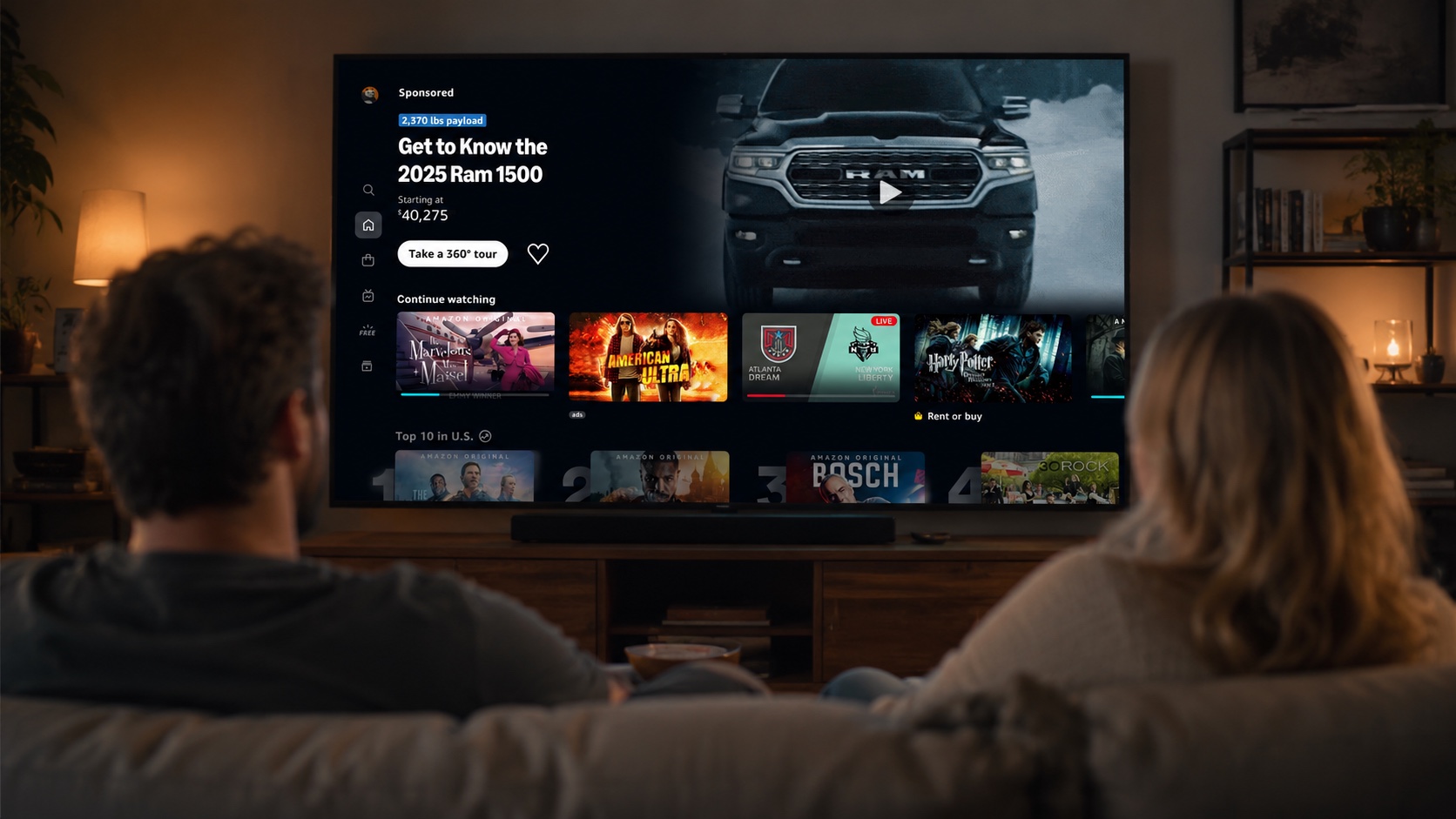
Continue experience across Amazon Ecosystem (Prime, Alexa, Twitch, Music, etc)
Awareness:
Signals captured across the ecosystem continue the experience in a new setting. Here, a conquest ad appears on Prime Video based on earlier signals. The user can explore or save for later; if they save, a push notification links them to a comparison experience that brings them back to Amazon Autos.
Why it matters:
The journey survives across surfaces and picks back up on the customer's terms — the way a weeks-long decision actually happens.
Impact
This vision wasn't a concept that lived and died in a file. It gave Amazon Autos leadership a shared, concrete picture of where the customer-facing ad experience could go, aligned stakeholders across design, product, and the sales org around a single direction, and directly informed our multi-year (3-year) product strategy. (That roadmap is confidential and isn't shown here — but the vision's job was to shape strategy, and it did.)
What I'd validate next
A north star earns its keep by pointing somewhere — but it still has to be de-risked. The questions I'd take into research and testing next:
Relevance vs. creepiness. The generative-AI personalization is powerful and sensitive. Where does "helpful" tip into "how did they know?" — and what controls do customers need to stay comfortable?
Does re-targeting actually help, or just follow? This is the highest-risk, highest-reward idea, so I'd test it first — measuring whether the added utility changes how the placement is perceived.
Immersive ecosystem placements. Do conquest ads on Prime Video build brand desire, or intrude on the entertainment moment? A brand-lift and sentiment study would tell us.
Sponsored vs. organic balance. The vision threads sponsored content throughout the experience, so I'd want to confirm it lifts advertiser value without eroding trust in organic results — the exact tension I mapped in the strategy phase.