Role & Team
I led the exploration from research synthesis through strategy and concept development. I brought together existing buyer and dealer research, interviewed key stakeholders, mapped the tensions across the customer journey, and translated those findings into a set of design principles and exploratory concepts.
I partnered with product, research, and business stakeholders to pressure-test the direction from both sides of the marketplace. Every concept was evaluated through the same dual lens: Would it increase customer confidence, and would it help dealers communicate meaningful value?
Build their brand and stand apart from nearby competitors.
Know who they’re buying from and why that dealer is credible.
I also used AI to accelerate the synthesis of large volumes of customer and dealer feedback—surfacing recurring themes and testing different ways to frame the problem. I validated those themes against the original research before using them to inform the strategy.
Background
Amazon Autos launched with Hyundai through a private beta, bringing Amazon’s familiar shopping experience to car buying. But unlike a typical Amazon purchase, the vehicle was still sold and fulfilled by a local dealer.
That distinction created real friction on both sides. Customers sometimes reached the end of the journey believing they were buying directly from Amazon, only to discover that they were purchasing from a dealership. Dealers, meanwhile, felt obscured by the experience—reduced to fulfillment partners with few opportunities to explain what differentiated them from another dealer down the block.
The challenge wasn’t to remove dealers from the journey. It was to reposition them within it: making their role transparent to customers while giving them meaningful ways to communicate their value.
Sitting a dealer inside the Amazon promise pulled three stakeholders in conflicting directions at once:
Customers
Trust Amazon, but lack clarity about whether Amazon or the dealer owns each touchpoint.
Dealers
Feel obscured by the experience and reduced to fulfillment partners with little room to differentiate.
Business
Needs dealers to compete through clear differentiation that improves customer value and service.
The opportunity
After synthesizing customer and dealer research and speaking with stakeholders across the organization, a clear direction emerged:
Make dealers more visible—not as a compromise in the Amazon experience, but as trusted partners within it.
Greater visibility could set more honest expectations for customers while allowing dealers to differentiate through their services, benefits, offers, and reputation—not only vehicle price.
Approach
I translated the research into a strategic framework that examined every decision through two connected lenses:
Does this increase customer confidence?
Does this give dealers a meaningful way to demonstrate their value?
Using that framework, I explored how the dealer could become more visible throughout the journey—from discovery and consideration to purchase and ownership.
The concepts were intentionally rough and exploratory. They weren’t proposed as a final product solution. Their purpose was to make the strategy tangible enough for leadership to evaluate: Was repositioning the dealer a direction worth pursuing?
Goal & design principles
Build trust in the program
Position dealers as visible, trusted partners throughout the journey.
Differentiate dealers
Promotions, localized merchandising, and advertising products.
Leverage social validation
Ratings, successful transactions, and consumable trust signals.
Enable communication
Give buyers and dealers meaningful ways to connect.
Provide bite-size education
Explain how Amazon vets dealers at the moments that matter.
Concepts
Rather than searching for a single solution, I explored how dealer visibility could evolve across the entire ownership journey—from discovering a vehicle to evaluating an offer, completing the purchase, and maintaining the car afterward.
Together, the concepts made the strategic direction tangible: a dealer that wasn’t hidden behind Amazon, but integrated into the experience as a visible and differentiated partner.
Dealer visibility during major shopping events.
The concept: Give dealers a more visible role in major promotional events, using their offers, inventory, and reputation to strengthen the event’s value.
For dealers: Creates a high-visibility opportunity to stand out as a trusted partner rather than an anonymous fulfillment endpoint.
For customers: Makes it easier to discover timely offers from dealers whose credibility and value are clearly communicated.
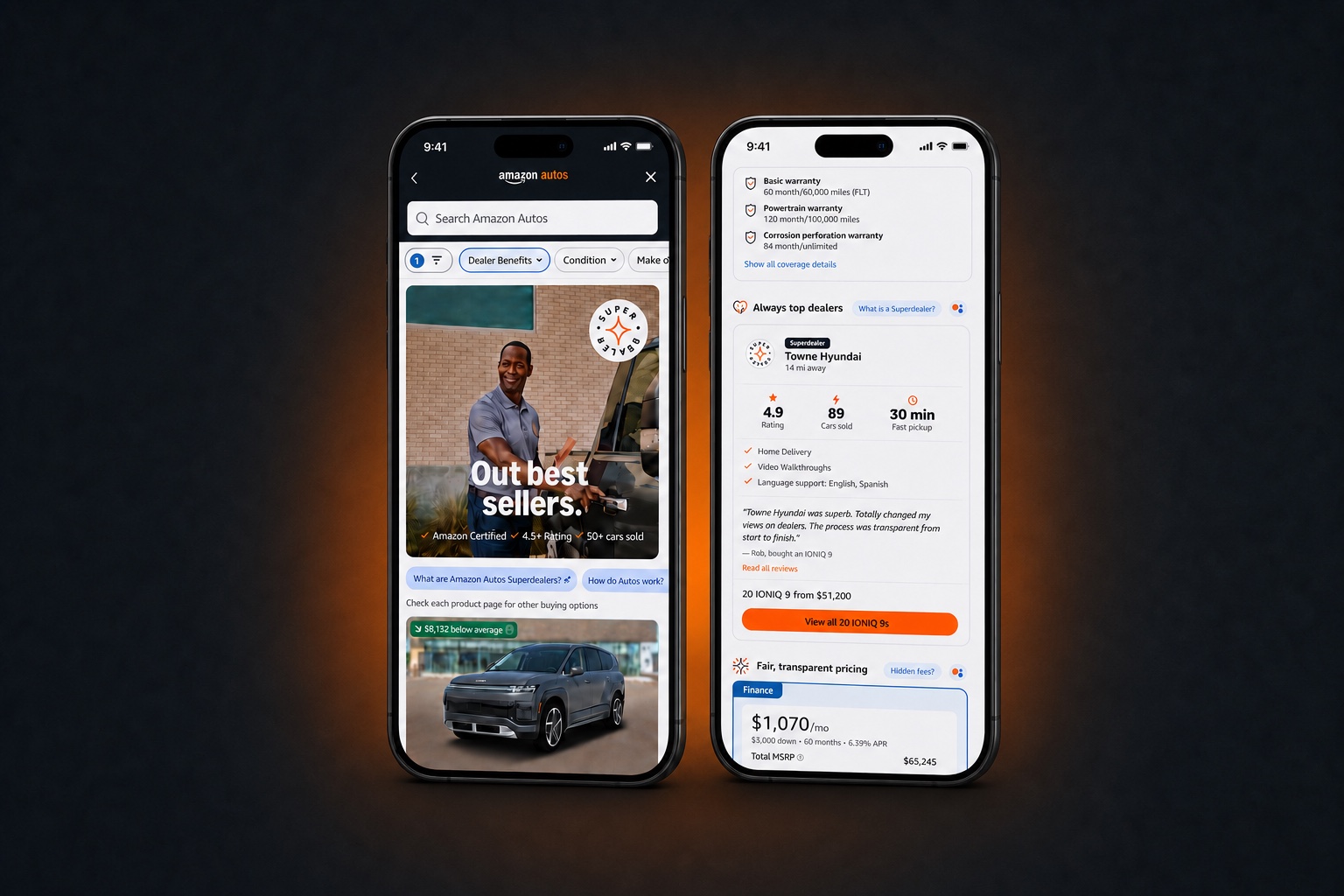
Dealer Benefits Filters
The concept: Allow customers to filter vehicles based on benefits offered by the dealer—not only vehicle attributes and price.
For dealers: Creates a way to differentiate through services and benefits they already provide offline, such as home delivery, extended warranties, multilingual support, or complimentary maintenance.
For customers: Makes those benefits visible and comparable earlier in the journey, when they can meaningfully influence the decision.
Dynamic Offers on Saved Vehicles
The concept: Let dealers send targeted offers when a customer has demonstrated strong intent by saving a specific vehicle.
For dealers: Creates an opportunity to convert high-intent shoppers without relying exclusively on broad price reductions.
For customers: Introduces the possibility of receiving a more compelling offer on a vehicle they already want—without restarting their search.
Alternative Deals During Deal Review
The concept: Surface comparable offers from other dealers before the customer commits to a deal.
For dealers: Gives dealers with stronger terms or differentiated benefits a fair opportunity to compete.
For customers: Provides a final point of comparison, increasing confidence that they have considered the best available combination of vehicle, price, and dealer value.
Continued Value Through Amazon Garage
The concept: Extend the dealer relationship beyond the transaction through relevant maintenance reminders, services, and vehicle-specific recommendations in Amazon Garage.
For dealers: Creates opportunities to maintain the customer relationship after purchase and generate longer-term service value.
For customers: Makes ownership easier by connecting maintenance needs and relevant products to the vehicle they already own.
Dealer Brand Stores
The concept: Give each dealer a dedicated destination where customers can understand who they are, browse their inventory, and explore the benefits they offer.
For dealers: Provides greater control over their story and a place to communicate what makes their dealership distinctive.
For customers: Creates a transparent, one-stop destination for evaluating both the available vehicles and the partner behind the purchase.
Impact & Learnings
The primary outcome wasn’t a shipped feature—it was greater organizational clarity.
The exploration transformed a loosely understood, two-sided tension into a concrete strategic direction. It gave leadership a shared buyer–dealer framework, identified where expectations and confidence broke down, and demonstrated what a more visible dealer experience could look like across the customer journey.
The work helped the organization evaluate a fundamental product question: whether Amazon Autos should continue minimizing the dealer’s presence or reposition dealers as visible, differentiated partners in the experience.